NVIDIA Rubin is the company's newest generation of AI computing. The engine designed to run the next wave of large language models, reasoning systems, and AI agents. Rubin is not a single chip but a complete, co-designed system: processors, memory, and networking built to work together so that an entire server rack behaves like one enormous accelerator.
NVIDIA calls these deployments “AI factories,” because their job is to turn electricity into useful intelligence as efficiently as possible.
This guide explains, in accessible terms, how Rubin evolved from the previous Blackwell generation, what it now demands of a data center in electrical power and liquid cooling, and how to decide between the two ways to buy it: the rack-scale Vera Rubin NVL72 and the smaller, more flexible HGX Rubin NVL8.
How we got here: from Hopper to Rubin
NVIDIA now ships a major step forward roughly every year. Each generation keeps the same core idea but increases performance and lowers the cost of running AI:
- Hopper (2022): the H100 era that powered the first generation of large language models.
- Blackwell (2024): introduced the first “rack-scale” design, where 72 GPUs in one rack act as a single system rather than as separate servers.
- Blackwell Ultra (2025): a mid-cycle boost to memory and performance.
- Rubin / Vera Rubin (2026): the new generation covered here, ramping into production in the second half of 2026.
Blackwell proved that the rack (and not the server) should be the basic building block of an AI data center. Rubin takes that proven idea and pushes every part of it forward at once: faster chips, much more memory, and dramatically faster connections between GPUs. The result is a generation built specifically for today's most demanding workloads, such as reasoning models and mixture-of-experts systems that constantly shuffle data between many GPUs.
What changed between Blackwell and Rubin
At the rack level, NVIDIA quotes up to 5x the inference performance and, just as important for budgets, about 10x lower cost per token versus the previous Blackwell generation, meaning each unit of AI output costs a fraction of what it did before.
What it means | Blackwell Ultra (B300) | Rubin GPU |
AI compute (NVFP4 inference) | 15 PFLOPS | 50 PFLOPS (~3.3x) |
On-chip memory | HBM3e, up to 288 GB | HBM4, up to 288 GB |
Memory speed | ~8 TB/s | Up to 22 TB/s (~2.8x) |
GPU-to-GPU link | 1.8 TB/s (NVLink 5) | 3.6 TB/s (NVLink 6, 2x) |
Transistors | 208 Billions | 336 Billions |
Companion CPU | Grace (72 Arm cores) | Vera (88 custom Arm cores) |
More memory means a single GPU can hold bigger models and longer conversations. Faster GPU-to-GPU links mean large models split across many GPUs spend less time waiting and more time working. Together, that is why Rubin can do far more work for the same power and cost, but it also packs more of that work into every rack, which is why power and cooling now matter more than ever.
NVIDIA Rubin Platforms: Vera Rubin NVL72 vs HGX Rubin NVL8
Both platforms use the exact same Rubin GPU and the same fast networking. They differ in scale (how many GPUs work together as one) and in flexibility. That is the heart of the decision.
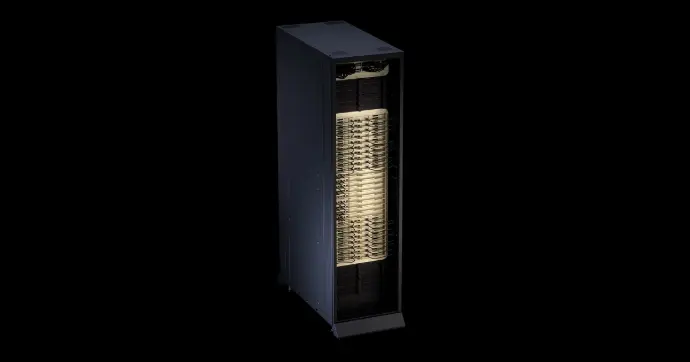
Vera Rubin NVL72: the rack-scale powerhouse
The NVL72 turns a full, liquid-cooled rack into a single giant accelerator: 72 Rubin GPUs and 36 Vera CPUs all wired together so that any GPU can talk to any other at full speed.
It delivers 3.6 EFLOPS of inference compute, 20.7 TB of ultra-fast HBM4 memory, and is built for the very largest training runs and high-traffic AI services.
This is the configuration hyperscalers and AI labs reach for when the model is too big to fit anywhere else.
HGX Rubin NVL8: the flexible building block
The NVL8 brings the same Rubin GPUs into a compact 2U server with 8 GPUs, drawing roughly 24 kW per node.
It delivers 400 PFLOPS of inference compute and, crucially, can be paired with either NVIDIA's Vera CPU or standard x86 processors (Intel Xeon or AMD EPYC).
That makes it easier to add to existing data centers, repeat across many racks, and use for a mix of AI and traditional high-performance computing.
Like every Rubin system, it is direct-liquid-cooled only. There is no air-cooled version. It is the practical on-ramp to Rubin for most enterprises.
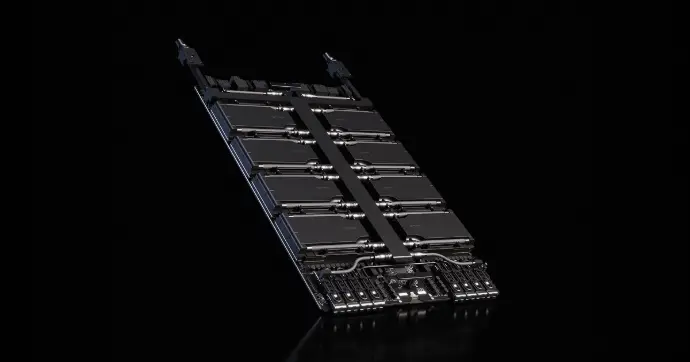
Although it ships as a single node, the NVL8 is also designed to run at rack scale: several 2U nodes are installed in one cabinet and linked over the scale-out network, building toward dozens of Rubin GPUs per rack.
The difference from the NVL72 is the interconnect. Each NVL8 node is its own self-contained 8-GPU NVLink domain, joined to the others by Ethernet or InfiniBand, rather than the NVL72’s single unified 72-GPU NVLink fabric. For many workloads that independence is an asset: nodes can be allocated, scaled, and serviced separately, and a rack can be filled gradually.
Interconnect topologies
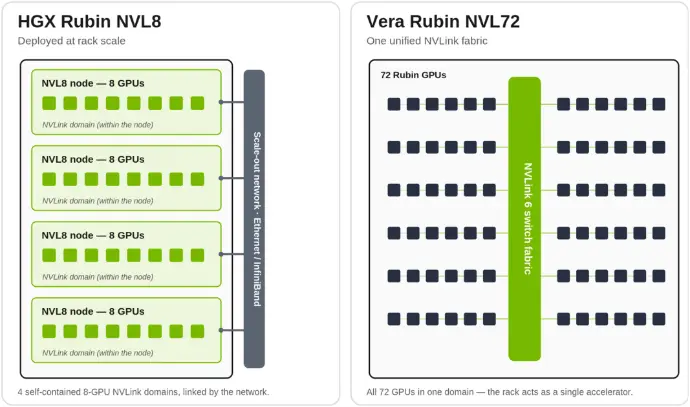
Left: a rack of independent HGX Rubin NVL8 nodes: each a self-contained 8-GPU NVLink domain joined over Ethernet/InfiniBand.
Right: the Vera Rubin NVL72’s single 72-GPU NVLink fabric, in which every GPU reaches every other at full speed.
NVIDIA Rubin Platforms Comparison
At a glance | Vera Rubin NVL72 | HGX Rubin NVL8 |
Form factor | Full liquid-cooled rack | 2U node (rack-scalable) |
Rubin GPUs | 72 | 8 |
CPU options | 36 Vera CPUs | Vera or x86 (Xeon / EPYC) |
Inference compute | 3.6 EFLOPS | 400 PFLOPS |
Memory bandwidth | 1.6 PB/s | 176 TB/s |
Power (approx.) | ~190–230+ kW / rack | ~24 kW / 2U node |
Cooling | Direct-to-chip liquid (required) | Direct-to-chip liquid (required) |
Built for | Largest models, max scale | Flexible, repeatable deployment |
Blackwell vs Rubin: Mixture-of-Experts Performance
Mixture-of-experts (MoE) is the architecture behind nearly every frontier model today: GPT-class systems, DeepSeek, Mixtral and the latest agentic models. Instead of a single dense network, an MoE model splits its layers into many smaller “experts”, and a routing layer sends each token to only a handful of them.
Because the experts live on different GPUs, every routing step triggers an all-to-all communication burst: each GPU sending tokens to many others and receiving tokens back, all at the same time. The speed of that step often decides the speed of the whole model.
This is exactly where the two platforms diverge. On the Vera Rubin NVL72, the all-to-all traffic stays inside the unified 72-GPU NVLink fabric at 3.6 TB/s per GPU bidirectional, with uniform latency and no congested edges. NVIDIA reports up to 2x higher MoE all-to-all throughput versus the previous generation, and in-network compute (NVIDIA SHARP) accelerates collective operations directly inside the NVLink switch, making the rack behave, for MoE inference, as one giant 72-GPU accelerator.
On the HGX Rubin NVL8, the same MoE step splits across two networks: fast NVLink within each 8-GPU node, then a step down to the scale-out network (ConnectX-9 over Ethernet or InfiniBand at roughly 1.6 Tb/s per GPU) the moment a token has to leave its node.
That is roughly 18x less GPU-to-GPU bandwidth than the NVL72’s NVLink fabric, plus additional latency from network hops. For models that fit inside a single 8-GPU node, the NVL8 is perfectly suited; for the very large MoE models that drive today’s most ambitious deployments, the NVL72 is purpose-built.
NVIDIA Rubin Power Requirements and Liquid Cooling
Rubin's performance comes with a blunt physical truth: these racks are extraordinarily dense, and the building around them has to be ready. For the first time, NVIDIA makes liquid cooling mandatory: there is no air-cooled version of Rubin. Planning power and cooling is no longer an afterthought; it is part of choosing the platform.
Why Rubin racks consume up to 230 kW
A Blackwell Ultra (GB300) NVL72 rack already draws around 140 kW, roughly the electricity of a hundred homes packed into one cabinet. A Vera Rubin NVL72 pushes well beyond that, with industry estimates and vendor reference designs putting it in the 190 to 230 kW per rack range, depending on the Rubin SKU (up to ~220 kW TDP for the 2 300 W variant).
To deliver that much power efficiently, NVIDIA is preparing a transition to an 800 VDC power architecture that will progressively replace the traditional 415/480 VAC feeds and 48V in-rack distribution. Higher voltage means less current, thinner conductors and fewer conversion losses, essential as the roadmap heads toward 600 kW racks (Rubin Ultra "Kyber", 2027) and eventually 1-megawatt racks.
For now, Vera Rubin NVL72 racks are shipped in the traditional configuration, four 110 kW power shelves converting 415/480 VAC to 48 VDC and feeding a liquid-cooled busbar rated up to 5,000 A, with 800 VDC available as an optional sidecar for operators who want to anticipate the next generation (Rubin Ultra).
Rubin racks also introduce Intelligent Power Smoothing to cushion the sudden power swings that large AI jobs create as thousands of GPUs ramp up and down together, cutting peak current demands by up to 25 % and reducing the need for massive external battery packs.
Why Rubin requires 100% Direct Liquid Cooling
Rubin uses 100% direct-to-chip liquid cooling. Instead of fans blowing cold air, coolant flows through metal cold plates pressed directly onto each GPU and CPU, absorbing heat right at the source, where it can capture roughly 98% of the heat a rack produces. The system is single-phase warm-water DLC: coolant enters the rack at about 45°C and leaves at roughly 55–65°C after collecting heat.
Using warm rather than chilled water is deliberate. It removes the need for energy-hungry mechanical chillers in many climates, lets data centers reject heat with simpler dry coolers, and (because the water comes out hot enough) opens the door to heat reuse: district heating, industrial preheating, or water treatment.
A device called a CDU sits between two loops: the sealed technology loop that runs through the racks, and the facility water loop that carries heat out to the building and ultimately outdoors. As a rule of thumb, one CDU serves on the order of ten racks, and facility CDUs are scaling to several megawatts of heat-removal capacity.
What Rubin asks of the facility, versus Blackwell
Power & cooling | Grace Blackwell Ultra NVL72 (Previous generation) | Vera Rubin NVL72 |
Approx. rack power | ~135 kW | ~190–230 kW (CPX variant ~370 kW) |
Power delivery | 415/480 VAC + 48V in-rack | 415/480 VAC + 48V in-rack Moving to 800 VDC |
Cooling method | Air (10%), Direct liquid cooling (90%) | 100% Direct liquid cooling |
Coolant inlet temp. | Up to 45°C (warm-water, single-phase) | Up to 45°C (warm-water, single-phase) |
Figures are industry estimates; confirm against vendor specs for your configuration. Sources: NVIDIA, DataCenterDynamics, The Cooling Report.
Is your data center ready?
Both Rubin platforms require direct-to-chip liquid cooling, there is no air-cooled fallback. Before ordering, confirm three things:
- enough electrical capacity and the move toward higher-voltage/DC power delivery;
- a facility water loop with CDUs sized for your rack count; and
- a plan for the heat, rejection or reuse. Facility readiness, not chip availability, is the most common thing that delays a Rubin deployment.
Which one should you choose between Vera Rubin NVL72 and HGX Rubin NVL8?
The simplest way to decide: start with the size of your ambition, then check what your facility can deliver in power and cooling. If you are training or serving the very largest frontier models and want the lowest possible cost per token at maximum scale, the NVL72 is built for exactly that, provided you can supply 150 kW or more and high-temperature liquid cooling per rack.
If you want Rubin-class performance that fits a more gradual buildout and your existing x86 standards, the NVL8 delivers the same Rubin GPUs as flexible 2U nodes (deployable singly or racked together at scale) while still requiring direct liquid cooling.
If this sounds like you… | Best fit |
Training frontier-scale or very large mixture-of-experts models | Vera Rubin NVL72 |
Running high-concurrency AI services at the lowest cost per token | Vera Rubin NVL72 |
Your facility can deliver very high power density and DLC per rack | Vera Rubin NVL72 |
You want Rubin performance without rebuilding your data center | HGX Rubin NVL8 |
You need x86 (Intel / AMD) CPU compatibility | HGX Rubin NVL8 |
You plan to grow capacity gradually, rack by rack | HGX Rubin NVL8 |
You want to phase in liquid cooling at a more moderate per-rack density | HGX Rubin NVL8 |
You want Rubin at rack scale as independent 8-GPU nodes, not one 72-GPU domain | HGX Rubin NVL8 |
You run mixed AI + HPC workloads or do a lot of fine-tuning | HGX Rubin NVL8 |
Both share the same Rubin GPU and both require liquid cooling - the choice is about scale, flexibility, and how much power and cooling you can deliver per rack.
Choose the NVL72 when scale and cost-per-token at the frontier matter most and your facility can feed and cool a 220 kW+ rack. Choose the NVL8 when flexibility, x86 compatibility, and a gradual buildout matter most.
Either way, liquid cooling is now the price of
entry - many organizations will start with NVL8 nodes and graduate to NVL72
racks as both their workloads and their facilities mature.
Beyond the rack: the Vera Rubin AI POD
The two platforms in this guide, NVL72 and HGX NVL8, are the building blocks. NVIDIA’s full Rubin ambition is a tier higher: the Vera Rubin POD, announced as “five connected rack-scale systems, one AI supercomputer” built specifically for the era of AI agents. Where a single NVL72 already acts like one giant GPU, the POD features 40 racks: nearly 20,000 NVIDIA dies, 1,152 Rubin GPUs, roughly 60 exaflops of compute, and 10 PB/s of total scale-up bandwidth.
What makes the POD different is that it is co-designed from seven chip types into five purpose-built rack types, each addressing a different stage of an AI agent’s work loop:
- Vera Rubin NVL72: the core GPU compute, for training and high-throughput inference.
- The Groq 3 LPX rack: 256 LPUs per rack, for ultra-low-latency response on long-context, trillion-parameter models.
- The Vera CPU rack: up to 256 Vera CPUs per rack, providing the dense CPU “sandboxes” where agents safely execute tools, run code and validate results.
- The BlueField-4 STX storage rack: AI-native storage with the new CMX context-memory platform, which offloads KV cache and serves it back across turns, sessions and agents.
- The Spectrum-6 SPX networking rack: silicon-photonics Ethernet/InfiniBand that ties the POD together with low latency and near-perfect effective bandwidth.
The reason all five exist is that an AI agent does not just “infer”, it plans, calls tools, executes code, retrieves data, then loops, sometimes across thousands of steps per prompt.
Those steps land on different kinds of hardware: GPU for reasoning, CPU for the sandbox, accelerator for instant response, storage for the context. By co-designing the five racks to operate as one, NVIDIA reports up to 10x more agent throughput at scale versus the previous Grace Blackwell generation. The Vera Rubin POD is, in effect, NVIDIA’s answer to the question: what does an AI factory for AI agents look like?
Should you choose Blackwell or Rubin?
Rubin continues the shift Blackwell started: AI infrastructure is now designed at the scale of the rack, with hardware, power, and cooling co-engineered to maximize useful intelligence per watt and per dollar.
The flip side of that density is a hard infrastructure requirement - high-voltage power and mandatory warm-water liquid cooling. With production ramping through the second half of 2026 and Rubin Ultra already on the roadmap for 2027, organizations planning AI infrastructure should pick the entry point that matches both their workload and their facility today - the rack-scale NVL72 or the flexible NVL8 - knowing both run the same next-generation Rubin engine and both expect a liquid-cooled, power-dense home.
And as workloads shift toward AI agents, both naturally compose into the larger Vera Rubin POD: five purpose-built racks acting as a single supercomputer for the agentic era.