Risers
Our R&D teams developed our own risers compatible with the OCtoPus servers and 1U or 1OU servers of other brands. Their main asset? They improve system efficiency and flexibility.
2CRSi's R&D risers
Here are the most recent updates from our R&D team regarding the development of risers.
Their newest designs offer enhanced functionality and integration options. The primary objective behind these innovations? To improve system efficiency and flexibility. For a detailed explanation of the technical goals and benefits, please reach out to the R&D team for a brief description.
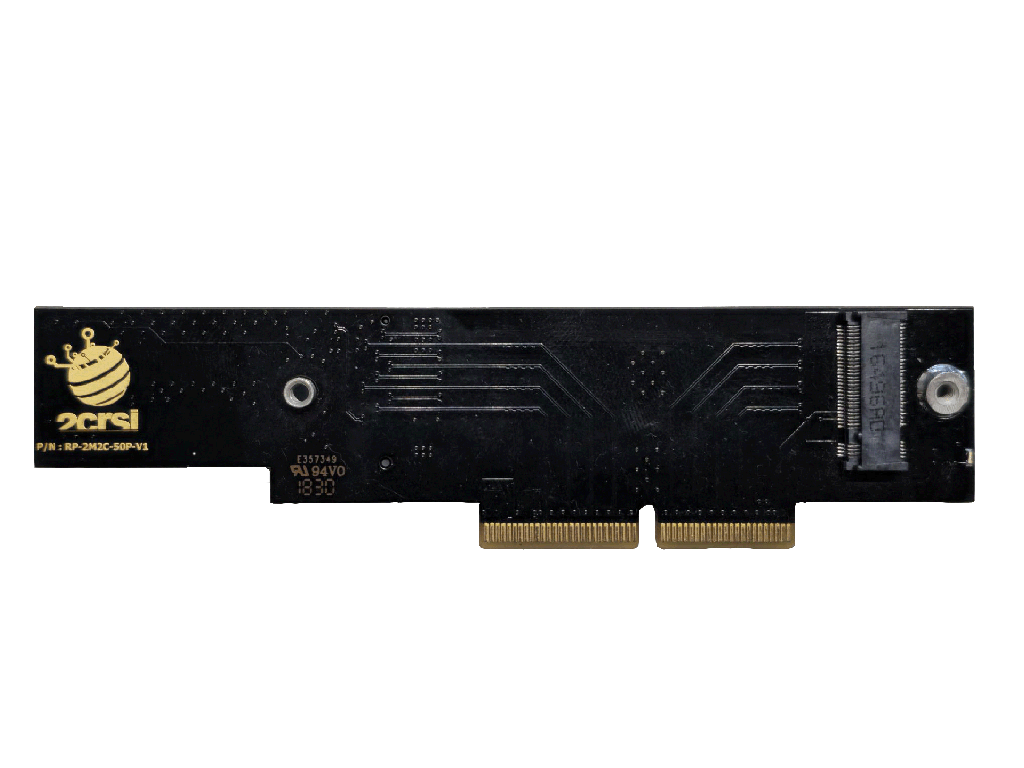
| Photo | Input Connection | Output Connection | Compatible systems | PCIe 3.0 | PCIe 4.0 | Size |
 |
PCIe x16 GF
| PCIe x16 | 1U OCtoPus and Atlantis 1.4 | Ready | Ready | 205,75 x 36,00 mm 8,10 x 1,42 inches |
 | PCIe x16 GF
| PCIe x16 |
1U OCtoPus and Atlantis 1.4
| Ready | 205,75 x 32,98 mm 8,10 x 1,30 inches | |
 |
Proprietary MG50 Mezz1 80p | 2x
M.2 M key 2280 | Only works with motherboards Gigabyte (MG50, MG51, MZ21,…) | Ready | In testing | 132 x 34.1 mm 5,20 x 1,34 inches |
 | Proprietary MG50 Mezz2 50p | 2x
M.2 M key 2280 | Only works with motherboards Gigabyte (MG50, MG51, MZ21,…) | Ready | In testing | 132 x 34.1 mm 1,26 x 1,34 inches |
 | PCIe x16 GF | PCIe x16 | 1U OCtoPus 1.4 | Ready | Ready | 205,75 x 36,00 mm 8,10 x 1,42 inches |
 | PCIe x4 GF | M.2 M key 2280 // 22110 with "2249830" adaptation kit | 1U servers | Ready | In testing | 103.8 x 32.3 mm 4,09 x 1,27 inches |
 | OCuLink (contenant 4 SATA) | 3x
SATA 3.5" host receptable |
1U servers
| Not designed for | 310 x 30 mm 12,20 x 1,18 inches | |
 |
1U servers
| Not designed for | 34 x 9.7 mm 1,34 x 0,38 inches | |||
 | PCIe x8 GF | 2x M.2 M key 2280 |
1OpenU servers | Ready | In testing | 132 x 34.1 mm 1,26 x 1,34 inches |
What are risers used for?
Risers are printed circuit boards that increase connectivity options in a computer or a server. Typically connected to PCIe or MCIO ports, they extend the connection between a motherboard and components like graphics cards, storage drives, or other peripherals.
Their use is not limited to changing existing outputs; they also allow the relocation of the original port to another location, freeing up space inside the tower or server. This creates room to accommodate a greater variety of components.
The main purposes are:

Cable Management
Provide more flexibility in cable routing, which helps improve system organization and cleanliness.

Enabling Multiple Components
Allow the installation of more GPUs or cards in a system, especially in high-performance servers or workstations.

Heat Management
By positioning components differently using risers, it can improve airflow, reducing heat buildup and enhancing cooling efficiency.

Space Optimization
Allow components like GPUs to be mounted horizontally or in different positions, making better use of limited space within a server rack or gaming case.